
Family-owned · Round rock Local
Fiber Cement Siding Installation in Round Rock, TX
James Hardie and comparable fiber cement board, installed for fire, pest, and hail resistance vinyl can't touch. One owner on every job, and the siding-to-roof transitions flashed by a crew that flashes roofs.
Call directly(737) 230-7099FreeEst.
Free Estimate
Tell us what you need.
Takes about a minute. We'll follow up within one business day. No pressure, no upsells.
Round rock · Trusted Locally
Why Choose Over and Above Contracting for Fiber Cement Siding Installation in Round Rock, TX
If you're looking at fiber cement siding installation for a Central Texas home, you're choosing the material built to survive what this climate throws at a wall: fire, pests, and hail that cracks vinyl on the first real storm. Over and Above Contracting installs fiber cement siding, James Hardie and comparable brands, across Round Rock and Williamson County, and because Mike Ennis runs both the roofing and the siding side of every job, the transition where your siding meets the roofline gets flashed by a crew that flashes roofs for a living. That seam is where water usually gets in behind siding here, and it's the detail a siding-only crew tends to leave for someone else. Call Mike directly at (737) 230-7099 for a free on-site estimate.
Here's the part most siding sales reps skip: fiber cement is only as good as what's behind it and how it's flashed. The board itself shrugs off golf-ball hail and won't warp in a 100-degree Round Rock August, but if the water-resistive barrier behind it is compromised or the kick-out flashing at the roof-wall intersection is missing, you get rot in the sheathing while the fiber cement out front looks brand new. Over and Above is owner-operated and insurance-claim experienced, so you get one accountable party for the barrier, the board, and every flashed transition. Every job is different. Contact Over and Above Contracting for an accurate estimate.
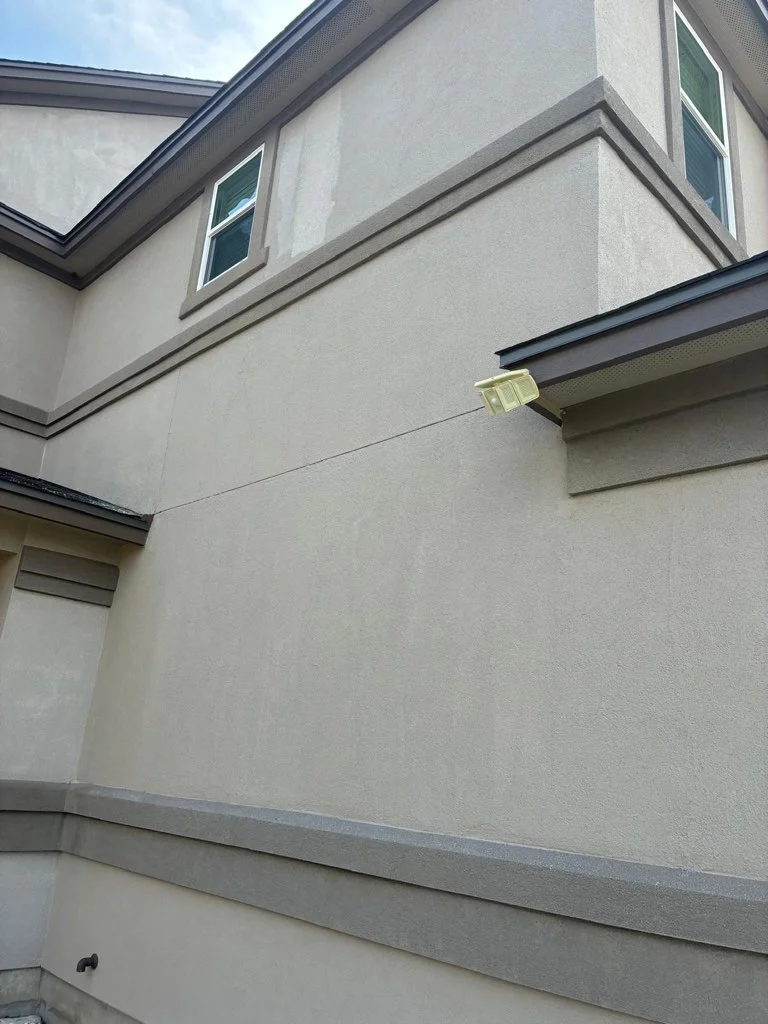
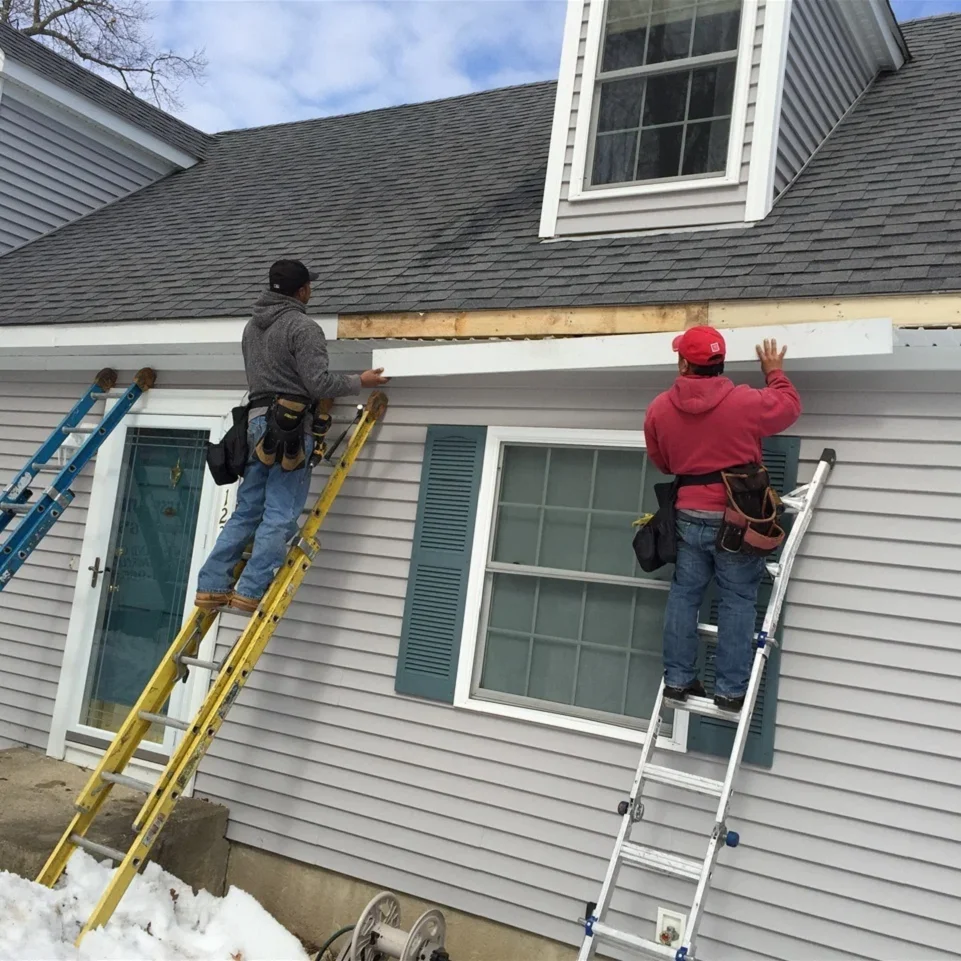
fiber cement siding installation detail showing the exterior wall and roofline on a Central Texas home
Fiber Cement Siding Installation: What the Job Actually Involves
A fiber cement re-side is a slower, heavier job than a vinyl hang, and the sequence is what separates a wall that lasts 30-plus years from one that traps water in its first wet spring. On a typical single-story Round Rock home the install runs several days, longer on a two-story or a cut-up elevation with lots of corners and penetrations.
The order of operations is the whole job, not a formality:
1. Tear-off and substrate inspection. The old siding comes off and the sheathing gets checked for rot, soft spots, and past water intrusion. On the pre-2000 housing stock common across older Round Rock and Pflugerville neighborhoods, this is where we routinely find failed housewrap that nobody knew about. 2. Water-resistive barrier. A continuous moisture barrier goes on before a single board. Fiber cement is cement board, not a raincoat, so the barrier behind it is what actually keeps your wall dry. Skipping or lapping this wrong is the number one reason new siding rots out a sheathing. 3. Flashing the transitions. Window and door heads, the base course, and critically the siding-to-roof intersections all get formed metal flashing. Kick-out flashing where a roof plane dies into a wall is the single most common missing detail we see on other crews' work. 4. Board layout and fastening. Fiber cement is cut with the right blades and fastened to the studs at the correct depth. Over-driven nails crack the board over time; under-driven ones let it move. We hang it to the manufacturer's spec, not to a volume quota. 5. Caulk, paint, and seal. Cut edges get sealed, gaps get caulked, and factory or field finish gets protected. A finished wall, not a framed-out job left for someone else to close.
Want the real number for your house? Call (737) 230-7099 and Mike will walk the exterior with you.
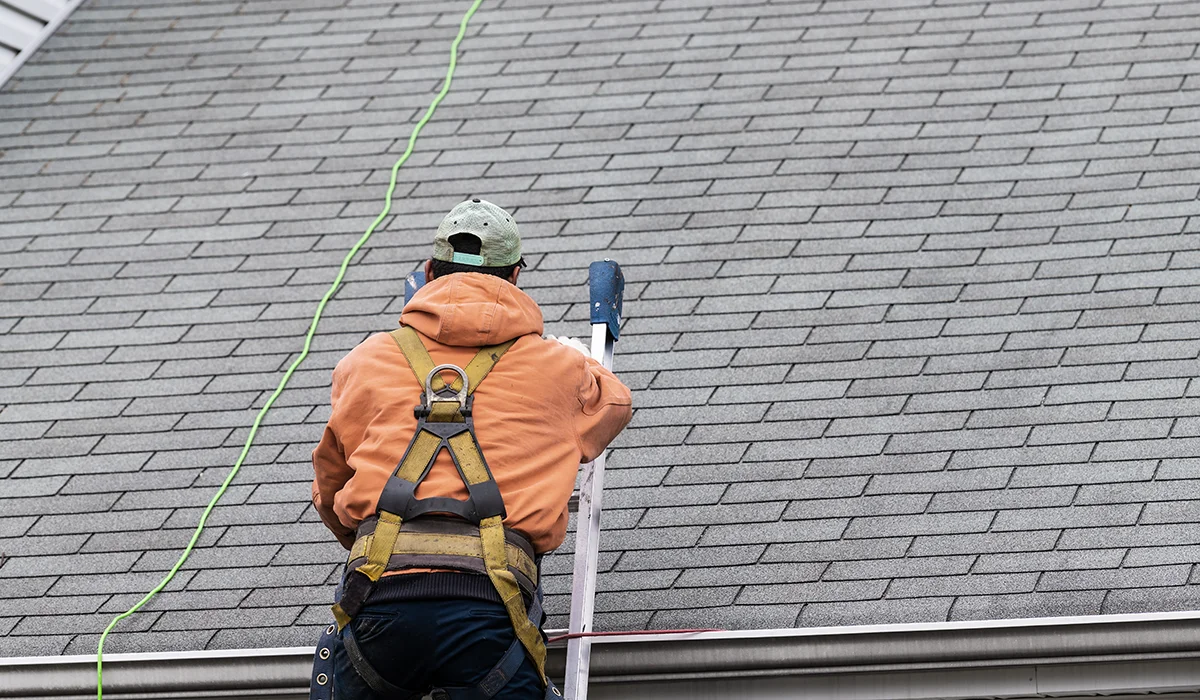
exterior work showing the roof-to-wall transition where fiber cement siding meets the roofline in Round Rock, TX
Fiber Cement vs Vinyl Siding: The Honest Comparison
Fiber cement versus vinyl siding comes down to what you want the wall to survive. Vinyl is cheaper to buy and faster to hang, which is why it covers most newer subdivisions across the north Austin suburbs. Fiber cement costs more up front in both material and labor, and in hail country that premium is buying you something specific.
Here's the plain-language breakdown of where each one wins:
- Hail and impact: Fiber cement is dense and impact-resistant. Vinyl dents, cracks, and shatters in a bad Central Texas hailstorm. This is the biggest reason homeowners here make the switch after a storm. - Heat: Vinyl that wasn't hung with proper expansion gaps buckles and oil-cans in sustained 100-degree heat. Fiber cement doesn't expand and contract dramatically, so it holds its line through our summers. - Fire: Fiber cement is non-combustible, which matters during the dry stretches when grass and brush fires flare up west of town. Vinyl melts and drips. - Pests: Fiber cement gives termites and woodpeckers nothing to work with. That's a real consideration in wooded parts of Williamson County. - Cost and upkeep: Vinyl wins on price and needs almost no maintenance. Fiber cement costs more and wants a repaint every so often, but it holds paint for years and lasts longer doing it.
"After a hail season in Round Rock, the vinyl calls are all replacement calls. The fiber cement calls are usually just a repaint. That difference is the whole argument, and it's why we lean toward fiber cement when the budget allows."
We'll price both honestly on the same estimate so you're comparing real numbers for your home, not a brochure. If you want to see how siding fits a larger exterior scope, read about our siding installation and repairs and exterior general contracting.
Why a Roofing Crew Flashes Siding Better
The boards get all the attention, but the transitions are where fiber cement siding actually succeeds or fails. The worst leaks we find are almost never in the middle of a wall. They're at the seams: where a roof plane runs into a wall, where a lower roof dies into a second story, and at every window and door head.
That's a flashing problem, and flashing is roofing work. A siding-only crew hangs the board beautifully and then leaves the roof-wall intersection to whoever did the roof, and the gap between those two trades is exactly where water gets behind the siding. Because Over and Above handles both roof replacement and repair and siding, those transitions are one scope and one accountable party. We form the kick-out flashing, step-flash the wall-to-roof line, and tie it into the water-resistive barrier the same way we'd detail a roof. One crew, one standard, no seam left for the other guy.
Fiber Cement Siding Work We Handle
Fiber Cement Lap and Panel
Panel and Section Repair
Storm and Hail Damage
Siding-to-Roof Flashing
Moisture and Rot Remediation
fiber cement siding installation detail showing the exterior wall and roofline on a Central Texas home
When Fiber Cement Siding Is the Wrong Call
Fiber cement isn't automatically the right answer for every house, and you deserve to hear that before you spend the money.
Hold off on a full fiber cement re-side, or at least get a second opinion, if any of these describe your situation:
- Your current siding is sound and only a few sections are damaged. Replacing a whole wall of good material because of localized hail hits is a waste of money. A panel-level repair is usually the right call. - You're selling within a couple of years. Fiber cement's payback is in decades of durability and lower storm risk. If you won't own the home long enough to capture that, a well-installed vinyl re-side often returns more at resale for less up front. - The budget is tight and the home is protected from hail. On a shaded lot with little storm exposure, the fiber cement premium may not pencil out over quality vinyl hung correctly. We'll tell you when that's the smarter spend.
Mike would rather lose the job than sell you an upgrade you don't need. If fiber cement isn't right for your home yet, he'll say so, and he'll tell you what to do instead. Call (737) 230-7099 for a straight read.
Get a Free Fiber Cement Siding Estimate from Mike
Whether you're set on fiber cement or still weighing it against vinyl, Mike will walk your exterior and give you a straight assessment. No sales pitch, no pressure, no obligation. Call (737) 230-7099 or send the details through the contact page and we'll come back with an honest number and a scope that includes every flashed transition.
FAQ Common questions
Frequently Asked Questions
Answers below
How much does James Hardie siding installation cost? +
James Hardie and comparable fiber cement siding installation costs more than vinyl on both material and labor, because the board is denser, heavier, and requires specialized cutting tools and fasteners to install correctly. The number for your home depends on square footage, the number of stories, how many corners and penetrations break up the runs, whether there's rot or failed housewrap behind the old siding, and the finish you choose. A straightforward single-story re-side on sound sheathing sits at the low end; a two-story with complex elevations and hidden substrate repair climbs from there. Every job is different. Contact Over and Above Contracting at (737) 230-7099 for an accurate estimate after a site visit.
Is fiber cement siding better than vinyl in Central Texas? +
For most Central Texas homes exposed to hail, fiber cement outperforms vinyl where it counts. It's impact-resistant, so it doesn't crack and shatter the way vinyl does in a bad hailstorm, and it holds its shape through sustained 100-degree heat instead of buckling the way poorly installed vinyl can. It's also non-combustible and gives pests nothing to work with. Vinyl still wins on up-front cost and needs less maintenance, so it's a reasonable choice on a protected lot or a shorter ownership horizon. The honest answer depends on your home's storm exposure, your budget, and how long you plan to own it, and we'll price both so you can compare real numbers.
How long does fiber cement siding last? +
Installed correctly, fiber cement siding commonly lasts 30 to 50 years in Central Texas, outlasting vinyl and standing up better to hail over that life. The board itself is extremely durable, but the real determining factor isn't the brand on the box, it's whether the water-resistive barrier behind it stays intact and whether the transitions are flashed right. Water that gets behind the siding at an unflashed roof-wall seam rots the sheathing and ends the job early no matter how good the board is. That's why we inspect the substrate and flash every transition before new material goes up. Occasional repainting keeps the finish looking right over the decades.
Does fiber cement siding hold up to Texas heat? +
Yes. Fiber cement handles sustained heat far better than vinyl because it doesn't expand and contract dramatically through the seasons, so it won't buckle or oil-can in a 100-degree Round Rock August the way poorly installed vinyl can. It also won't fade or soften in direct sun. The one heat-related detail that matters on install is clearance: the base course has to be set to spec above grade and off the roofline so it isn't wicking runoff water, and in our expansive-clay soils that heave every wet season, that clearance is something we set carefully on every job.
Can you repair just a few boards of fiber cement siding? +
Yes, and that's often the right call rather than a full replacement. Individual fiber cement boards can be replaced section by section when the surrounding material is sound and a reasonable profile and color match is available. The main challenge is matching older product lines that may have changed, and if we can't get a close match we'll tell you upfront instead of leaving you with a patchwork wall. Partial repairs are standard and don't require tearing out material that doesn't need it. If hail hit your siding, we can also document the damage to support an insurance claim.
Do you install fiber cement siding in Round Rock and Williamson County? +
Yes. Over and Above Contracting installs fiber cement siding across Round Rock, Pflugerville, Georgetown, and the greater Austin area throughout Williamson County. Mike Ennis runs every job personally and knows the local conditions that matter: the wind-driven hail that cracks vinyl here, the expansive-clay soils that affect base-course clearance, and the older housing stock where failed housewrap hides behind the old siding. Because Over and Above handles both roofing and siding, the roof-wall transitions get flashed as one scope. Call (737) 230-7099 to schedule a free on-site estimate.
Related
Explore
You Might Also Need
Metal Roof Installation
Standing-seam, metal-over-shingle, and ridge-cap metal roof installation for Salado, Round Rock, Temple, and Austin homes. Talk to Mike at…
Roof Inspection
Free, no-cost roof inspection service in Round Rock and Central Texas. Certified visual and drone inspections, storm and hail assessments.…
Soffit & Fascia Repair
Rotted or peeling soffit and fascia? Over and Above Contracting repairs water-damaged soffit and fascia across Round Rock and Central Texas.…
Local
Areas We Serve
- Roundrock, TX
- Salado, TX
- Temple, TX
- Architectural Shingles Vs 3 Tab Round Rock Roofing Guide, TX
- Austin, TX
- Book A Free Roof Inspection This Fall Round Rock, TX
Guides
From the Blog
Why Local Storm Restoration Contractors Matter After A Major Texas Storm
After a major Texas hailstorm, who you call matters. Learn why local storm restoration contractors outperform out-of-town crews for Round…
Roof Repair Vs Replacement Hail Damage
Repair or replace after a Central Texas hailstorm? Mike Ennis breaks down the decision factors, what the adjuster looks for, and when a…
Choosing The Right Roofing Contractor 6 Factors To Consider
Don't hire the wrong roofer. Here are 6 critical factors — licensing, local reputation, experience, and more — to help you make a confident,…